
If you have spent the last few days reading PSP marketing pages that all say "we understand high-risk" and tell you nothing useful, this page is the opposite of that. It is written for operators, existing and new shop owners, and distributors, helping them determine which payment setup they need before launching or expanding a social casino platform. We are not selling processing. Games Island runs the distributor side of this business, which means the honest answer to "which payment solution should I buy" is sometimes "none of it, yet." That is the argument this page makes, and it is not one you will find on a page written by someone trying to sell you a merchant account.
What iGaming Payment Solutions Actually Mean for a US Social Casino Operator
Most content on iGaming payment solutions is written for a licensed operator holding a Malta or PAGCOR license, subject to UKGC audits and PSD2 rules. If that is not you, and it is not most of our readers, almost none of that advice applies directly.
A US social casino operator operating under a storefront or distributor model is not acquiring card payments in the traditional iGaming sense. You are not the merchant of record for a regulated gaming product. You are buying credits wholesale and distributing them to players, which changes what "payment solution" even means for your business. This distinction is the entire reason the rest of this page exists; most guides assume you need a full PSP stack from day one. Many operators do not. If you are still working through the broader launch sequence beyond payments specifically, how to start a sweepstakes business is the fuller starting point.
The Five Layers of a Payment Stack, and Which Ones You Actually Own
Every payment stack breaks into five layers: the payment service provider (PSP), the acquiring bank, the payment gateway, fraud tooling, and payment orchestration routing on top. Competitors publish this list constantly. What they never include is the ownership column, since each of them is selling you a piece of it.
|
Layer |
What It Does |
Direct-Cashier Model |
Distributor Model |
| PSP | Holds the merchant relationship, underwrites your risk | You own this | Your distributor owns this |
| Acquiring bank | Settles funds into a bank account | You own this | Your distributor owns this |
| Payment gateway | Encrypts and routes transaction data | You own this | Your distributor owns this |
| Fraud tooling | Screens transactions, flags risk | You own this | Bundled with credit access |
| Orchestration | Routes across multiple rails for approval optimization | You own this, if you need it | Not your problem |
If you are running a direct-cashier model, an igaming payment gateway and everything underneath it is genuinely your responsibility to source, secure, and maintain. If you are buying credits wholesale through a distributor, most of that stack is not yours to build at all; it is bundled into the relationship. Understanding igaming payment processing in your specific model is the first real decision this page can help you make, since most guides to iGaming payment solutions skip straight past this fork and assume you already know which side of it you're on.
Do You Even Need a PSP on Day One?
Here is the question nobody selling you a payment stack will ask honestly: do you need one at all, on day one?
Run through this in order. Are you acquiring card payments directly, under your own merchant identity? If yes, you need a full PSP relationship, and everything in the sections below applies directly to you. If no, are you issuing your own credits, or buying them wholesale through a distributor? If you are buying wholesale, the PSP question largely becomes your distributor's problem, not yours. Are you also taking cash in person at a physical counter? If so, the hybrid model in the next section is where you actually live operationally.
The honest endpoint for a large share of new operators is this: you do not need to solve the payment stack question on day one, because a wholesale credit relationship removes most of it from your plate entirely.
Buying Credits Wholesale Instead of Building a Stack
This is the actual alternative to sourcing a PSP relationship yourself. Sweepstakes platforms operate on a credit model, in which the platform vendor, not you, bears the merchant relationship and the compliance overhead that comes with it.
How Credit Access Actually Works
The mechanics matter here, since "buying credits wholesale" is not self-explanatory the first time you hear it. How operator accounts and credit wholesale pricing work walks through account setup, credit purchasing, and distribution in practical terms.
Deposit and Withdrawal Rails Compared
Here is a position worth defending directly: more payment methods is not better. Every competitor guide on iGaming payment solutions implies breadth wins: more rails, more player convenience, more approval odds. That is only half true. Each rail you add costs integration time, ongoing reconciliation effort, and its own compliance overhead, and a rail sitting at 2% adoption is not flexibility; it is a liability you are still maintaining for almost no return.
|
Rail |
Operator Cost |
Settlement Speed |
US Approval Odds |
Chargeback Exposure |
Integration Effort |
| Cards | High (interchange + scheme fees) | 1-3 business days | Moderate, high-risk MCC codes drag approval | High | High |
| E-wallets | Moderate | Same day to 1 day | Moderate to good | Low to moderate | Moderate |
| Bank transfer / open banking | Low | 1-3 business days | Good | Low | Moderate |
| Crypto (BTC, USDT, USDC) | Low | Minutes | Not applicable, no card-network approval process | Effectively none | Low, if using an existing rail |
Among the igaming payment options available to a social casino operator, crypto stands out for a specific reason beyond speed: it sidesteps the card-network risk classification that makes card processing so difficult for this category in the first place. Stablecoins like USDT and USDC provide dollar-denominated settlement without any card-scheme exposure.
That said, treating crypto as your only rail is its own risk, since not every player wants to acquire crypto just to fund an account, which is why a crypto payment gateway for igaming typically sits alongside at least one traditional rail rather than replacing it outright. If you are weighing which igaming alternative payment methods actually deserve a place in your stack, the honest filter is adoption rate against maintenance cost, not theoretical coverage.
What Card Processors Do When They Work Out What You Are
This is the section nobody selling you a PSP will say this plainly, because it is bad for their pitch.
Card processors classify merchants by Merchant Category Code, and social casino activity commonly falls under or near MCC 7995, the code card networks use to flag high-risk gaming-adjacent activity. Processors treat this classification as high-risk, and high-risk classification changes what happens to your account in ways that are rarely explained upfront.
Decline rates run higher. Card networks apply additional scrutiny to transactions flagged under high-risk MCCs, and legitimate transactions get declined more often than a standard retail merchant would see.
Rolling reserves lock up your cash. A rolling reserve is a percentage of processing volume the processor holds back, often over a fixed rolling window, as protection against future chargebacks. This directly affects available cash flow, since money already processed is not necessarily money you can access.
Chargeback monitoring carries real termination risk. Both major card networks run active monitoring programs for merchants exceeding certain chargeback thresholds. Visa's acquirer risk documentation and Mastercard's chargeback program page describe the mechanics directly, and exceeding these thresholds is a common way for an account to be terminated rather than fined.
The MATCH list is the outcome operators fear most. Getting placed on this shared database of terminated merchants makes acquiring a new merchant account meaningfully harder industry-wide, not just with the processor that terminated you.
The Hybrid Counter: Cash In, Digital Out
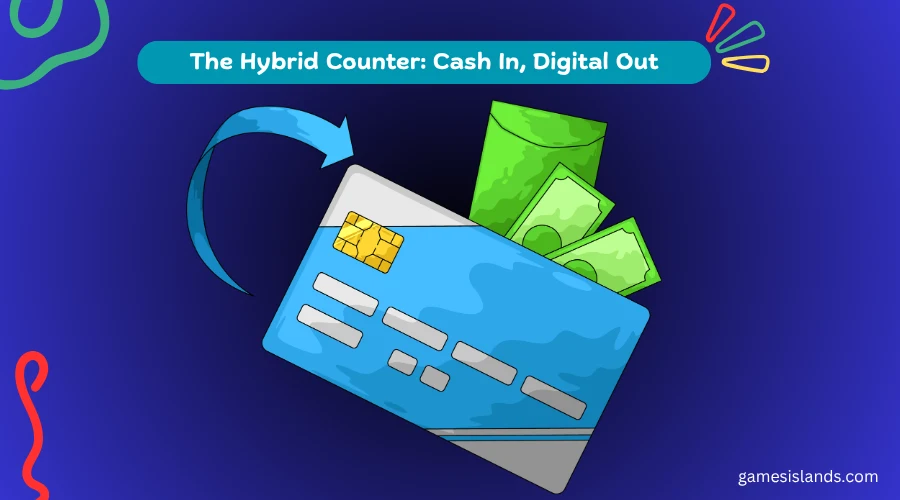
This is the operating model nobody in the top-10 results has written down, because every ranking page assumes a purely online operator. A US storefront that takes cash at a physical counter and pays out digitally does not exist in their worldview, yet it is the actual daily reality for a meaningful share of our readers.
The mechanics that matter: cash taken in person needs to reconcile cleanly with the digital credits issued in exchange, and the point where this breaks down is almost always due to timing, not fraud. A shift where cash intake and credit issuance are not logged against each other in real time creates a gap that is hard to trace after the fact, even when everyone involved is acting honestly.
Where Payment Costs Actually Land in Your Startup Budget
Every competitor discusses fees in the abstract, "2.9% plus FX markup," without ever converting that into a line item next to everything else you are spending money on before you open. Fees mean nothing to a pre-launch operator until they are shown alongside software costs, credit purchases, and marketing spend in a single monthly view.
The Full Startup Cost Breakdown
Payment setup is one of several lines. The sweepstakes business startup cost breakdown lays out the full month-one budget, so payment costs can be weighed against everything else you are funding at the same time.
Comparing This Against Software Costs
Payment setup and platform software are usually the two largest line items competing for the same early budget. Online casino software price breaks down the other side of that comparison.
How to Choose an iGaming Payment Provider: Our 6-Question Checklist
This is the framework we actually use when an operator asks us where to start.
- Are you acquiring payments directly, or buying credits wholesale? This single answer determines whether the next five questions are even yours to answer.
- What is your realistic monthly volume in the first 90 days? Underestimating this leads operators into providers built for a scale they will not reach for months.
- What is your actual chargeback tolerance? Not the number on paper, the number your business model realistically generates, since fish-table and slot-style engagement patterns differ from what a typical high-risk PSP has modeled.
- How quickly do you need player withdrawals processed, and what happens if they are not processed? Slow payouts are one of the fastest ways to lose player trust in this category.
- What rolling reserve terms are actually on the table? Get this in writing before signing, not after your first month of processing.
- Is a wholesale credit relationship a better fit than a direct PSP at your current stage? For a genuine share of new operators, the honest answer is yes, and asking this question last rather than first is exactly the mistake this checklist exists to prevent.
An igaming payment provider evaluated against these six questions tends to reveal itself quickly; either the vendor holds up, or the gaps show up fast. For a closer look at how specific platform options compare once you have answered question one, VegasX vs FireKirin vs RiverMonster platform comparison is worth reading alongside this checklist.
Frequently Asked Questions
What are iGaming payment solutions, and does a social casino operator actually need them?
The stack of tools- PSP, gateway, fraud screening, orchestration- that move money in and out of a platform. A direct-cashier operator needs most of it; an operator buying credits wholesale through a distributor typically does not.
Can I just use Stripe or PayPal for a social casino platform?
Generally no. Mainstream processors explicitly restrict gaming-adjacent categories, and accounts in this space are routinely closed once the activity is identified, often with funds held during the review.
What is MCC 7995, and does it apply to a storefront operator who is not licensed?
It is the merchant category code that card networks use to flag high-risk gaming-adjacent activity, applied based on transaction patterns rather than licensing status. That means it can apply to you regardless of whether you hold a traditional gaming license.
How much do iGaming payment solutions cost per transaction, honestly?
It varies by rail and risk classification, but expect meaningfully higher rates than standard retail processing for card-based options, plus a rolling reserve that reduces your available cash. Crypto and bank-transfer rails typically cost less, with different trade-offs in player adoption.
What is a rolling reserve, and how much of my cash will it lock up?
A percentage of your processing volume the processor withholds, usually over a rolling window of several months, as protection against future chargebacks. Get the exact percentage and window in writing before you sign, not after your first processing cycle.
Which deposit method has the best approval rate in the US right now?
Bank transfer and open banking, since both avoid card-network risk classification entirely. Crypto sidesteps the approval-rate question altogether by not routing through card networks.
Do I need a merchant account before I launch, or can I open without one?
Not necessarily. If you are buying credits wholesale through a distributor, the merchant account question largely belongs to your distributor, which is the central argument of this page.
How fast should player withdrawals be processed, and what happens if they are not?
Faster is always better, and crypto rails meaningfully outperform card and bank rails here. Slow or unreliable withdrawals are one of the most direct ways operators lose player trust in this category.
What chargeback rate gets a processor to terminate my account?
Thresholds vary by processor and network, but both major schemes run monitoring programs that trigger scrutiny and, eventually, termination once chargeback rates exceed a defined percentage of volume. Confirm your specific processor's threshold directly.
Is crypto a safe primary deposit rail, or should it only ever be a backup?
It is genuinely viable as a primary rail, and it avoids card-network risk entirely. Whether it should be your only rail depends on your player base, since some players will not use it.
Do KYC and AML checks apply to me if I am not a licensed operator?
Generally yes, in some form, since these obligations typically attach to whoever handles funds movement, not solely to gaming licensure. The FinCEN Bank Secrecy Act and AML guidance is the authoritative federal reference for structuring your own payment flows.
What to Do Next
If you take one thing from this page, take this: figure out whether you are actually the merchant of record before you shop for a payment stack, since that single answer determines whether the rest of iGaming payment solutions on the market are even your problem to solve, or someone else's. Get operator access if a wholesale relationship is the better fit for where you are right now.