

Every other article on casino games with best odds is written for the player sitting at the table. This one is written for the person who bought the table. If you're a US sweepstakes or social-casino operator sourcing titles for your floor, you need a house-edge table, the gap between theoretical and actual hold, and a framework for picking titles, not tips on how to lose less money.
Casino Games With Best Odds: The 2026 House-Edge Table
Here's the table-stakes answer, ranked by theoretical house edge under optimal play. This isn't the whole story, but it's where every evaluation starts.
|
Game |
Typical House Edge |
Equivalent RTP |
Typical Volatility |
What It Does to Operator Hold |
| Blackjack (basic strategy) | ~0.5% | 99.5% | Low-medium | Thin margin, high volume needed |
| Craps (pass line + full odds) | Under 1% | 99%+ | Medium | Margin shrinks further as odds multiple increases |
| Video poker (full-pay) | ~0.46% | 99.54% | Low-medium | Among the thinnest theoretical edges available |
| Baccarat (banker bet) | ~1.06% | 98.94% | Low | Steady, low-variance hold |
| Roulette | 2.7%–5.26% depending on wheel type | 94.74%–97.3% | Medium | See comparison note below |
| Slots (low-volatility) | 4–6% | 94–96% | Low | Steady, predictable hold pattern |
| Slots (high-volatility) | 8–12%+ | 88–92% | High | Highest theoretical margin, least predictable timing |
| Fish / skill-based titles | Configurable, no fixed edge | Not applicable | Skill-influenced | Governed by configuration settings, not a single fixed number |
Blackjack has the best odds of any casino game, with a house edge around 0.5% under basic strategy, the lowest theoretical edge on this list, closely followed by video poker's full-pay tables.
Casino games with the best odds on paper don't always translate to the best margin in practice, and that gap between best odds in casino math and real revenue is exactly what the rest of this guide unpacks.
What "Best Odds" Actually Means: House Edge, RTP, and Hold
Three numbers get conflated constantly, and untangling them matters before you make any sourcing decision.
House Edge vs RTP — The Same Coin, Two Sides
RTP and house edge always add up to 100%. A 96% RTP slot carries a 4% house edge. Say it once, plainly: they're the same fact, described from two angles. RTP is the term you'll see in back-office configuration screens. What is a casino house edge? It's the term you'll use in your P&L, since that's the language investors and accountants actually speak, and it's the direct input into your gross gaming revenue, or GGR, the actual dollar figure a game generates before operating costs.
Theoretical Hold vs Actual Hold — Why Your Reports Never Match the Math
This is the section that earns this page its place on your reading list. Theoretical hold is the house edge. Actual hold is what actually lands in your account after real players, real variance, real session lengths, and real bonus credits get involved. And the gap between the two is large.
Real Nevada Gaming Control Board data makes this concrete. Basic-strategy blackjack carries a theoretical edge of around 0.5%. Actual reported hold on Nevada blackjack tables has historically run closer to 12-14%, according to state revenue reports. Craps, theoretically under 1% with full odds, has held around 15-17% in the same reporting series. That gap isn't a rounding error; it's the entire difference between the math and the money, and it's why house edge casino games figures alone never fully predict what shows up in your account. Historical average and variance-band data for these figures are compiled by the UNLV Center for Gaming Research, a useful reference if you want to see how much monthly hold typically swings around these averages.
Why the gap? Players rarely play optimal strategy, session lengths compound the house edge over more hands than a single-round calculation captures, and bonus credit and comps shift the effective wager base. On low coin-in volumes, actual hold can sit 200-400 basis points away from theoretical for weeks at a time before enough volume lets the math assert itself. New operators frequently panic in week one, assuming a game is misconfigured, when what they're actually seeing is normal variance that hasn't yet converged.
Which Casino Game Has the Best Odds (and Why That's the Wrong Question for Operators)
Blackjack. That's the direct answer, and it's the one every other article on this topic stops at.
Here's the position worth taking instead: the best-odds game is rarely the best-margin game. A 0.5% house edge on a game nobody plays generates zero revenue. Hold is a rate. Revenue is that rate multiplied by coin-in, the actual dollar volume flowing through the game. A high-edge game with strong player engagement and heavy coin-in will out-earn a low-edge game sitting empty on your floor every single time.
This reframes what "the games players believe they can win money on" actually means for your business. Players chase favorable odds. Operators need engagement and volume, and those two goals aren't automatically aligned. For the broader catalog of titles available to build your floor around this reality, sweepstakes gaming platforms for operators cover what's currently accessible.
The Margin Paradox: Why Low-House-Edge Games Make More Money
The formula from the last section, revenue equals hold rate times coin-in, plays out in real accounts in a way that surprises a lot of new operators.
Picture two comparable operator floors running roughly similar total traffic. One leans heavily on a high-edge, short-session title; players spin quickly, cash out, and leave. The other leans on a lower-edge title with a longer average session, players stay engaged, coin-in accumulates over more spins per visit, and total revenue per active account ends up higher over a 90-day window despite the lower theoretical edge. The lower-edge, longer-session title wins on volume, what it gives up on rate.
The takeaway: never evaluate a title on house edge alone. Session length and engagement multiply against that edge to determine actual revenue, and a game that keeps players playing longer can out-earn a mathematically "better" game that gets abandoned after one session.
Volatility Is the Variable
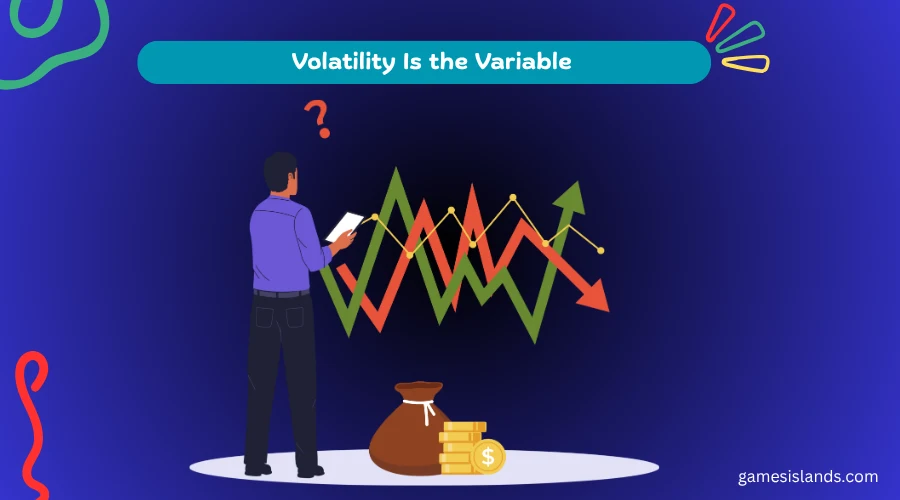
Volatility describes how unevenly wins get distributed around the theoretical average, and it's a cash-flow problem for operators, not a thrill mechanic for players.
A high-volatility title can carry an excellent theoretical hold on paper and still put an under-capitalized operator underwater for weeks before the math catches up. Big, infrequent wins mean long stretches where the house pays out more than the theoretical edge predicts, purely due to variance, not a broken game.
As a rough operating rule we use internally, low-volatility titles tend to converge on their theoretical hold within a few thousand spins or hands. Medium-volatility titles often need tens of thousands of rounds. High-volatility titles can take substantially longer, sometimes hundreds of thousands of rounds, before actual hold reliably tracks the math. This is our own operating heuristic, not a universally published industry standard.
The practical implication: don't load a high-volatility title onto a thin bankroll expecting the theoretical edge to show up quickly. Budget for the convergence period, or you'll make a bad decision based on a few weeks of noise, exactly what almost happened in the case above.
How Sweepstakes and Social-Casino Odds Differ From Real-Money Casino Odds
Every ranking page on this topic is written about land-based or licensed real-money casinos. None of them touch the sweepstakes model, which runs on fundamentally different mechanics.
Sweepstakes and social-casino platforms operate on virtual currency rather than direct cash wagers, typically using a dual-currency structure: one for free entertainment play and a second tied to a no-purchase-necessary entry method, with prize redemption available once eligibility requirements are met. This isn't gambling in the traditional regulatory sense; it's a promotional model, and state-level rules around it vary meaningfully. This isn't legal advice; operators should confirm their specific state's requirements with counsel before launching.
What changes practically for odds: RTP configuration on a sweepstakes platform is typically more flexible than on a licensed real-money game, since you're not bound by a single jurisdiction's regulatory RTP floor the way a licensed slot might be. Reporting also tends to run differently, focused on redemption and engagement metrics rather than a strict cash win/loss ledger.
Fish Games and Skill-Based Titles: The Odds Model Nobody Publishes
Fish and arcade-style titles don't run on a fixed per-spin house edge the way a slot or table game does. Instead, the return is governed by a configurable pool combined with a genuine skill component, weapon choice, targeting accuracy, and timing, all of which affect an individual player's outcome in a way a slot's fixed math never does.
When we set up a fish title for a new operator, the configuration setting is one of the first things we walk through together, and it's also the setting operators most consistently misjudge on their first pass. Setting it too conservatively starves the game of the big, memorable wins that keep fish-table players engaged and coming back. Setting it too aggressively can erode margin faster than a comparable slot would, since skilled players can meaningfully outperform an average player on the same setup. Getting this dial right takes more hands-on calibration than a slot's RTP setting ever does.
Fire Kirin fish game platform is one example in our catalog where this configurable model is core to how the title actually performs on a floor.
The Operator's Title-Selection Framework
Here's the 2×2 we actually use internally when a new operator asks us what to load first.
|
|
Low Volatility |
High Volatility |
|
Low House Edge |
Steady, predictable, thin margin. Best for established floors with strong existing traffic. | Rare combination in practice; treat cautiously if offered. |
|
High House Edge |
Reliable margin without big cash-flow swings. Best for new operators with a thin bankroll who need predictability first. | Highest margin potential, but requires real capital reserves to survive the convergence period. Best for established floors with a diversified game mix already absorbing variance. |
This is the matrix we use when a new operator asks us what to load first, and our default recommendation for a first-time operator with a thin bankroll is the high-edge, low-volatility quadrant specifically. It gives you real margin without the multi-week variance swings that can spook a new operator into pulling a perfectly good title too early.
For a broader look at which established platforms fit which quadrant well, the VegasX operator platform covers a catalog with strong coverage across multiple volatility bands.
Configuration Mistakes That Destroy Good Odds
Five mistakes we'd flag directly, based on patterns we see repeat across new operator accounts.
- Setting RTP at the top of the permitted band to chase retention. This looks generous short-term, but compresses your margin exactly when you need it most, during the early weeks when you're still building a bankroll cushion.
- Mixing volatility bands in the same lobby row. Players comparing two visually similar titles with wildly different variance profiles get confused, and your reporting gets muddier as you try to isolate what's actually driving the swings.
- Launching a new title without a 30-day hold baseline. Without a baseline, you can't tell whether a slow week is normal variance or an actual configuration problem.
- Treating theoretical hold as a weekly guarantee. It's a long-run average. Panicking over one bad week and swapping titles constantly prevents any title from ever reaching convergence, similar to the volatility case earlier in this guide.
- Ignoring session-length data when picking replacements. A title with a slightly worse theoretical edge but meaningfully longer average sessions can outperform a "better" title on paper, exactly the margin paradox covered earlier.
Before You Add a New Title: The Pre-Launch Checklist
The step almost every operator skips, run through this before any new title goes live on your floor.
- Confirm the RTP band your vendor permits for that specific title before committing to a setting.
- Baseline your current blended hold across your existing floor so you have something real to compare against.
- Set a variance tolerance in advance, how far below the theoretical hold you're willing to sit before you intervene, rather than deciding reactively in week one.
- Confirm reporting granularity with your vendor; daily blended hold isn't the same as per-title hold, and you need the latter to actually evaluate a new addition.
- Set a 30-day review date on the calendar now, not as an afterthought once you're already anxious about early numbers.
- Confirm credit-sourcing documentation is in order before the title goes live, not after a player dispute forces the question.
How Games Island operator onboarding works walks through how this checklist fits into the broader setup process when you're working with a verified vendor.
Baseline your blended hold before you touch your current game mix, then choose new titles against the 2×2 above rather than chasing whatever headline RTP a sales pitch leads with. Real casino games with best odds of winning rarely translate directly to real operator margin, and that distinction is the entire reason this page exists.
Get operator access when you're ready to apply it to your own floor.
Frequently Asked Questions
Which casino game has the best odds?
Blackjack, under basic strategy, carries the lowest theoretical house edge of any common casino game, around 0.5%. Video poker and craps with full odds run close behind.
What is a casino house edge?
The built-in mathematical advantage a game holds over players, expressed as a percentage of each wager the house expects to retain over a large number of rounds. House edge and RTP are the same number viewed from opposite directions.
What casino game has the best odds of winning?
Blackjack, video poker, and craps with full odds all carry theoretical house edges under 1% with optimal play, the lowest in the category.
What game has the best odds in a casino for a new player?
Video poker with a full-pay table tends to be the most approachable option, since the strategy is more mechanical to learn than blackjack's full basic-strategy chart, while still carrying a comparably low theoretical edge.
Is RTP the same thing as odds?
Not exactly. RTP describes the long-run percentage of wagers returned to players, while "odds" more broadly can refer to the probability of specific individual outcomes. They're related but not identical concepts.
Do casino games with best odds make less money for the operator?
Not necessarily, and this is the core reframe this page makes. Revenue depends on hold rate multiplied by coin-in and session length, not hold rate alone. A low-edge game with strong engagement can out-earn a high-edge game with weak engagement.
What RTP should an operator set on a slot title?
It does not just depend on the slot title but also depends on your bankroll, your player base, and your tolerance for volatility. Setting RTP at the top of the permitted band to chase short-term retention is a common mistake that compresses margin when you need it most.
How do sweepstakes casino odds differ from real-money casino odds?
Sweepstakes platforms run on virtual currency under a no-purchase-necessary, prize-redemption model rather than direct cash wagers, and RTP configuration is typically more flexible than on a licensed real-money game bound to a single jurisdiction's regulatory floor.
Do fish games have a house edge?
Not in the fixed, per-spin sense that a slot or table game has. Fish and skill-based titles run on a configurable pool combined with a genuine skill component, meaning outcomes vary more by player ability than by a single static edge figure.
How long does it take for actual hold to match theoretical hold?
It depends heavily on volatility. Low-volatility titles tend to converge within a few thousand rounds. High-volatility titles can take substantially longer, sometimes hundreds of thousands of rounds, before actual hold reliably tracks the theoretical number.
How much variance should an operator budget for when launching a new title?
Set a tolerance in advance, roughly 200-400 basis points below theoretical hold is a reasonable early-weeks range to expect on lower coin-in volumes, rather than reacting to every early swing as if something's broken.
Which game mix gives both good player odds and a healthy operator margin?
A blend across the 2×2 framework above, typically anchored by a high-edge, low-volatility title for predictable margin, supplemented by lower-edge titles that drive session length and repeat engagement, tends to balance both goals better than chasing either extreme alone.